Graph Valid Tree
Explore how to identify a valid tree in a graph by confirming all nodes are connected and no cycles exist. This lesson helps you implement an algorithm to verify graph validity, using edge lists and node connectivity concepts.
We'll cover the following...
Statement
Given n as the number of nodes and an array of the edges of a graph, find out if the graph is a valid tree. The nodes of the graph are labeled from to , and represents an undirected edge connecting the nodes and of the graph.
A graph is a valid tree when all the nodes are connected and there is no cycle between them.
Constraints:
-
n -
edges.length edges[i].length- ,
n - There are no repeated edges.
Examples
Understand the problem
Let’s take a moment to make sure you’ve correctly understood the problem. The quiz below helps you check if you’re solving the correct problem:
Graph Valid Tree
Consider the following graph with four nodes:
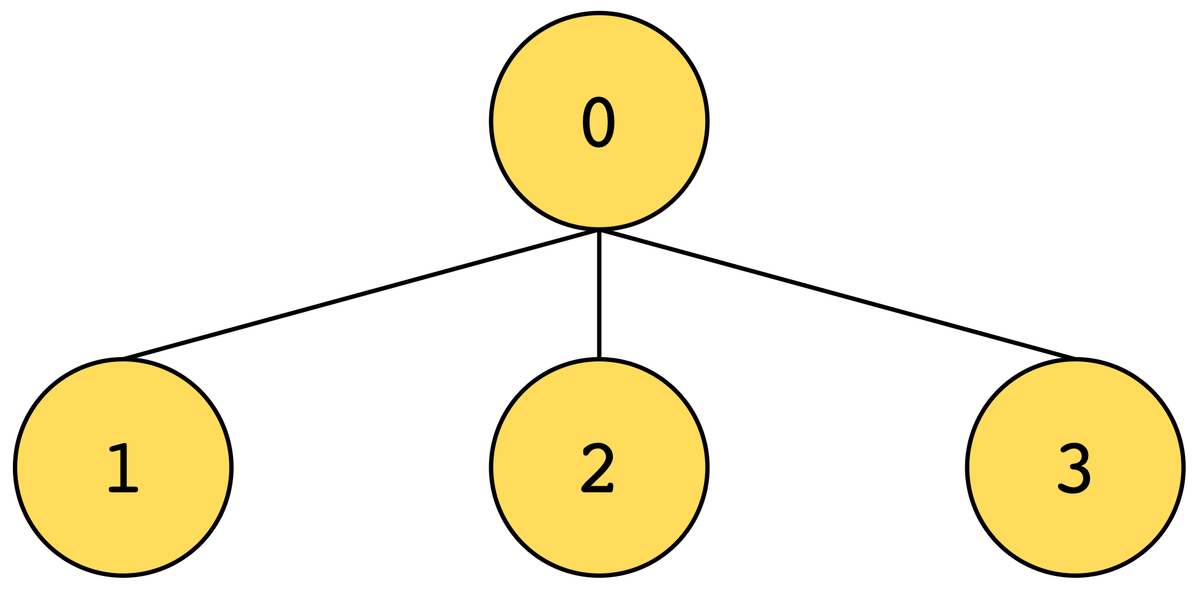
What is the correct array of connected edges that would make the graph above?
edges = [[0, 1], [0, 2], [0, 3]]
edges = [[0, 1], [0, 2], [1, 2]]
edges = [[0, 1], [0, 2], [2, 3]]
Figure it out!
We have a game for you to play. Rearrange the logical building blocks to develop a clearer understanding of how to solve this problem.
Try it yourself
Implement your solution in the following coding playground.
#include <iostream>#include <vector>#include <unordered_set>#include <stack>bool ValidTree(int n, std::vector<std::vector<int>>& edges) {// Replace this placeholder return statement with your codereturn false;}