Solution: Binary Watch
Explore how to apply backtracking to solve the binary watch problem by recursively toggling LEDs representing hours and minutes. Understand the recursion process, validity checks for time, and how to backtrack effectively to generate all possible valid times. This lesson also covers the time and space complexity analysis of the approach.
We'll cover the following...
Statement
A binary watch has 4 LEDs for displaying hours (ranging from 0 to 11) and 6 for displaying minutes (ranging from 0 to 59). Each LED can be on (1) or off (0), with the least significant bit on the right. For example, the binary watch below reads “9:22.”

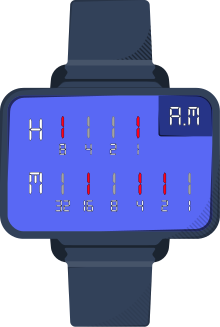
Given an integer enabled, which represents the number of LEDs currently turned on, return all possible times that the watch could display. You may return the answer in any order.
Note: Remember the following regarding leading zeros:
The hour cannot have a leading zero (e.g., “01:00” is invalid, it should be “1:00”).
The minute must be two digits and may include a leading zero (e.g., “10:2” is invalid, it should be “10:02”).
Constraints:
enabled
Solution
The core intuition behind solving this problem is to use backtracking to explore all possible configurations of the LEDs that can be turned on. Because there are