Redis Publisher/Subscriber Model
Explore the Redis publisher subscriber model to understand how Redis handles real-time messaging through dynamic channels. Learn to use commands like PUBLISH, SUBSCRIBE, UNSUBSCRIBE, PSUBSCRIBE, and PUNSUBSCRIBE to manage message flow between publishers and subscribers, enabling efficient asynchronous communication.
What is a message queue?
A message queue is a type of temporary storage for messages. The sender, also known as publisher, sends messages to the queue. The messages remain in the queue until a receiver also known as a subscriber, is ready to read the messages. The main use case for a message queue is when there are some larger jobs that need to be processed. The sender sends the jobs to a queue instead of directly sending it to the receiver. The receiver picks each job, one by one, and processes it.
Let’s say we are booking movie tickets on a website. There are a few things that should be done immediately, like selecting the seats, payment, etc. But a few things, like sending tickets via email, may take time and are not required to be done immediately. These tasks that time and are not required to be done immediately can be added to a queue and can be processed one by one.
How Redis is used as a message queue?
As we discussed earlier, Redis can also be used as a message queue. The publisher can publish to only one channel, although a channel may have multiple subscribers. A subscriber can subscribe to one or more channels.
Note: A channel in Redis Pub/Sub is simply a named string topic (like
notificationsororder_updates) that acts as a real-time message route between publishers and subscribers. It is not a physical queue, database table, or persistent object.
Now we will look at how the Redis can be used as a message queue.
Subscribing to a channel.
A user can subscribe to a channel using the SUBSCRIBE command. This command takes the name of the channel as an argument. The syntax of this command is:
SUBSCRIBE *channel*
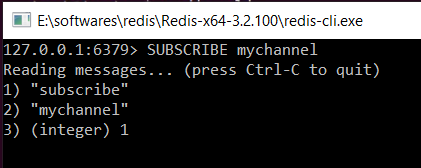
Note: Channels in Redis do not need to be explicitly created or configured beforehand. They are created dynamically on-the-fly as soon as a client issues a
SUBSCRIBEorPUBLISHcommand on a channel name (e.g.,SUBSCRIBE notificationsorSUBSCRIBE chat_room_1). Once all clients unsubscribe, Redis automatically frees the channel from memory.
Publishing to a channel
A user can publish to a channel using the PUBLISH command. The syntax of this command is:
PUBLISH *channel message*
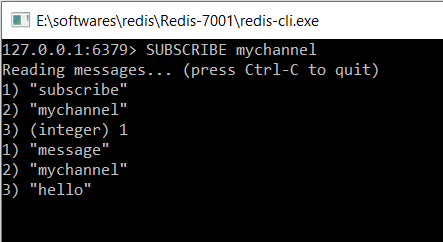
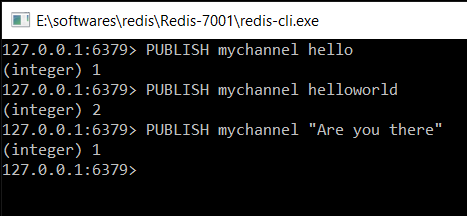
In the example below, the client publishes a message to a channel named mychannel (in a real-world application, channel names represent specific topics like order_updates or user_alerts).
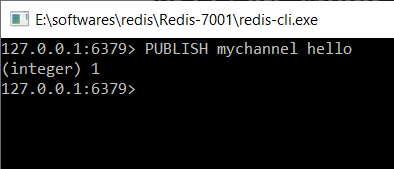
The message is sent to the other client.
A channel with multiple subscribers
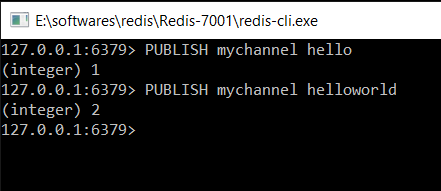
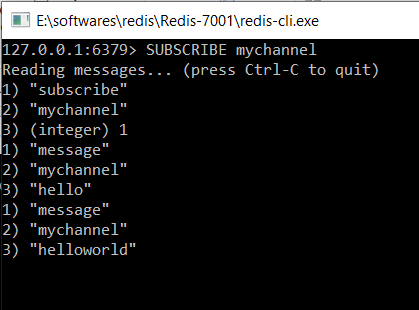
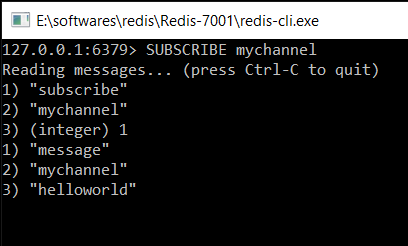
It is possible for different clients to subscribe to the same channel. Whenever a publisher publishes this channel, all the receivers receive the message.
In the example below, there are two clients subscribed to mychannel. When a publisher sends a message to this channel, both of the subscribers receive the update.
Unsubscribing from a channel in Redis
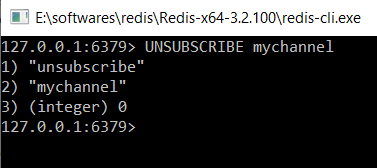
A client can easily unsubscribe from a channel using the UNSUBSCRIBE command. The syntax of this command is
UNSUBSCRIBE *channel*
In the example below, the client is unsubscribing from mychannel.
Subscribing to a group of channels
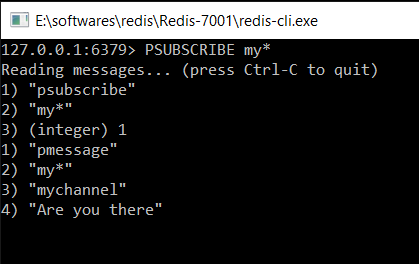
If a client wants to subscribe to all the channels starting with a particular character or string, they can use the PSUBSCRIBE command. The syntax of this command is:
PSUBSCRIBE *string**
In the example below, a client is subscribing to a channel that starts with my.
Unsubscribing from a group of channels
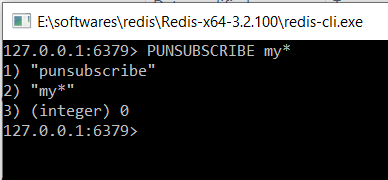
A client can unsubscribe to a group of channels using PUNSUBSCRIBE command.
In the example below, a client is unsubscribing to all the channels starting with my.
Now, let's answer a few questions to reinforce what we've learned about Redis Pub/Sub.
Redis Pub/Sub Quiz
Which of the following happens when a publisher publishes a message to a Redis channel with multiple subscribers?
Only the first subscriber receives the message.
All clients subscribed to the channel receive the message.
The message is stored until a subscriber requests it.