Grokking the Coding Interview Patterns in C++
The ultimate guide to coding interviews in C++, Grokking the Coding Interview Patterns in C++ teaches proven strategies developed by FAANG engineers to get interview-ready in just a few hours.
- Analyze and apply coding interview patterns to solve common algorithmic problems effectively.
- Implement dynamic programming techniques to optimize solutions for complex problems.
- Utilize hash maps to enhance data retrieval and frequency analysis in coding challenges.
- Employ depth-first and breadth-first search strategies to traverse and manipulate tree structures.
- Design and implement custom data structures to solve specific coding interview problems.
Demonstrate proficiency in solving algorithmic problems using established coding patterns, enhancing your interview performance.
Apply dynamic programming techniques to efficiently tackle complex coding challenges, showcasing your analytical skills.
Utilize hash maps for efficient data management and retrieval, enabling you to solve frequency-based problems with confidence.
Implement depth-first and breadth-first search methods to navigate and manipulate binary trees, preparing you for related interview questions.
Create and implement tailored data structures to address specific coding challenges, demonstrating your problem-solving capabilities.
Learn 28 Non-negotiable Coding Patterns
Master Advanced Algorithms and Data Structures
Mock Interviews for Every Coding Pattern
Put Your Skills to the Test
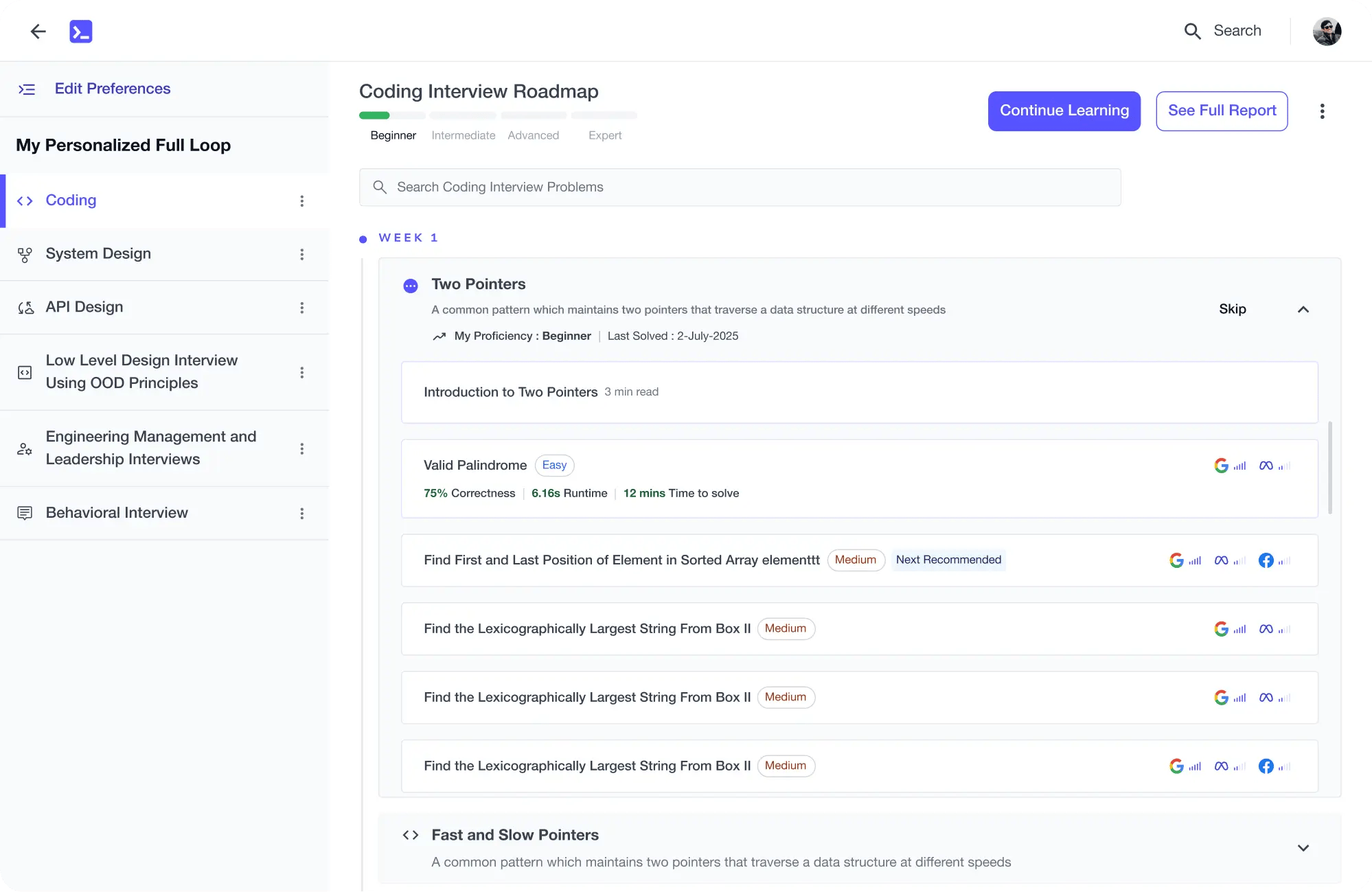
Learning Roadmap
Two Pointers
Get started with two-pointers to solve linear data structure problems efficiently.
Fast and Slow Pointers
Master the steps to use fast and slow pointers for cycle detection and mid-point identification.
Sliding Window
Break down the sliding window technique to solve computational problems with optimized efficiency.
Intervals
Solve problems in merging intervals, inserting and finding intersections of intervals, scheduler tasks, and determining employee free time.
In-Place Manipulation of a Linked List
Tackle in-place linked list manipulations for efficient and memory-optimized operations.
Two Heaps
Master the steps to optimize dynamic data processing and decision-making using heaps.
K-way Merge
Learn how to use k-way merge for efficient data merging and finding k-th small elements.
Top K Elements
Walk through the top k elements pattern and learn efficient selection using heaps.
Modified Binary Search
Break apart modified binary search adaptations and solutions for diverse search problems.
Subsets
Grasp the fundamentals of generating subsets, permutations, and combinations.
Greedy Techniques
Dig into optimization problems with greedy algorithms through practical scenarios and solutions.
Backtracking
Explore backtracking algorithm for solving complex problems like N-Queens, word search, binary tree paths, and Sudoku.
Dynamic Programming
Build on dynamic programming concepts to efficiently solve complex optimization problems.
Cyclic Sort
Step through cyclic sort concepts to efficiently handle various missing and corrupt number scenarios.
Topological Sort
Unpack the core of topological sort, focusing on ordering dependencies and resolving compilation sequences efficiently.
Sort and Search
Solve problems by organizing data through sorting and applying binary search, two-pointer, and sliding window for efficient solutions.
Matrices
Go hands-on with matrix operations, transformations, and efficient traversal techniques in coding.
Stacks
Apply your skills to use stacks for various tasks, including calculators, string manipulation, and queuing.
Graphs
Deepen your knowledge of graph theory, algorithms, practical solutions, and real-world applications.
Tree Depth-First Search
Follow the process of exploring tree structures and implementing various binary tree problems.
Tree Breadth-First Search
Piece together the parts of the Tree BFS traversal, focusing on various traversal methods.
Trie
Step through efficient trie implementations to optimize search suggestions, word replacements, and common prefix finding.
Hash Maps
Discover the logic behind implementing efficient hash maps and their applications in problem-solving.
Knowing What to Track
Master the steps to efficiently track data, solve permutations, anagrams, and game design problems.
Union Find
Enhance your skills in Union-Find to address diverse graph and connectivity problems.
Custom Data Structures
Dig into creating and implementing custom data structures for solving specialized problems efficiently.
Bitwise Manipulation
Explore bitwise operations for problem-solving and algorithm optimization.
Math and Geometry
Explore math and geometry for problem-solving.
Challenge Yourself
Test your understanding of various coding challenges focusing on algorithm efficiency.
Course Author:
Fahim ul Haq
Software Engineer, Distributed Storage at Meta and Microsoft, Educative (Co-founder & CEO)
Trusted by 3 million developers working at companies
Sanjukta S
Learner
Purnendu B
PNT Data
Keerthan S
Celstream Technologies
Built for 10x Developers